The Alatau City Governance System
The Alatau governance system is based on the separation of two functions: the strategic development of the city and its day-to-day administration. The former is provided by the Alatau City Council and the Alatau City Authority (ACA) – bodies established under a special legal regime. The latter is provided by the Akimat and Maslikhat, which operate in all cities of Kazakhstan. These levels are linked by common plans, budgetary decisions and accountability as prescribed by law. This model is applied in Kazakhstan only in Alatau and is enshrined in Presidential Decree No.1015 of 26 September 2025 and the Constitutional Law ‘On the Special Legal Regime of the City of Alatau’.
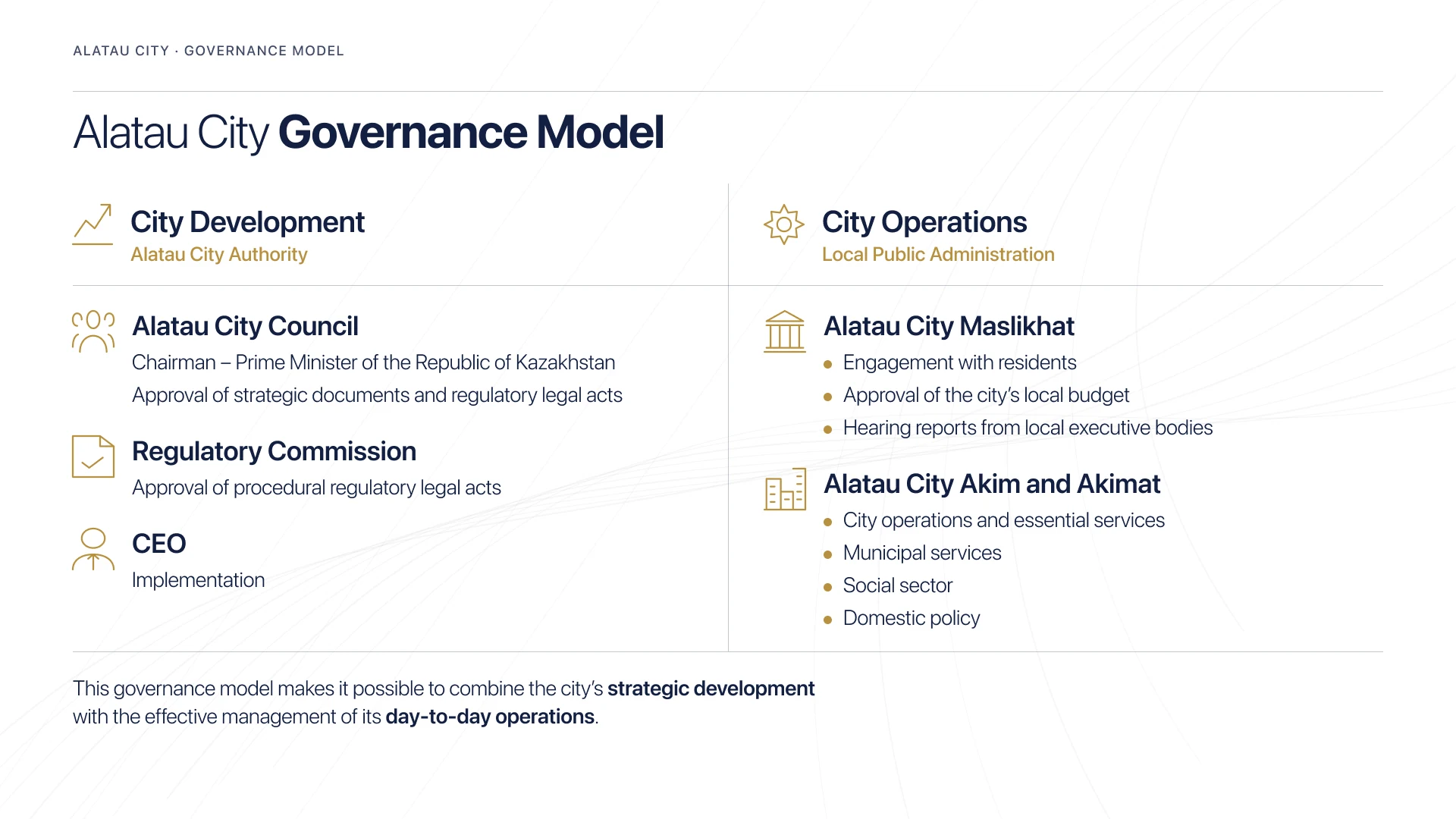
Why is Alatau’s system of governance organised differently?
In most cities in Kazakhstan, governance is carried out through two bodies: the Akimat (executive) and the Maslikhat (representative). In Alatau, these are supplemented by the Alatau City Authority – a special state body established specifically for the city. The highest governing body of the Alatau City Authority is the Alatau City Council, chaired by the Prime Minister of the Republic of Kazakhstan. This is not a duplication of functions: each institution is responsible for its own clearly defined set of tasks.
The reason for this structure lies in Alatau’s special status. The city is developing as a technology and investment hub. It is necessary to build infrastructure, attract investors and introduce new technologies here. Separate governing bodies have been established for these tasks, enabling them to focus on the city’s development and resolve issues in consultation with the country’s leadership. Day-to-day municipal matters are handled by the Akimat.
Strategic level: The Council and the ACA
The Alatau City Council is the highest collegial governing body of the Alatau City Authority (ACA), headed by the Prime Minister of the Republic of Kazakhstan. The Council determines the strategic directions for the city’s development, approves strategic documents, investment projects, the administration’s budget and its regulatory legal acts, and also considers the annual report on Alatau’s development.
The Alatau City Authority is a specialised state body responsible for the development of Alatau and the implementation of its special legal regime. The Alatau City Authority attracts investors, supports projects and organises the implementation of the city’s development plans. It coordinates infrastructure projects and liaises with other state bodies and international development institutions. Within the scope of its powers, the administration adopts regulatory legal acts and monitors their implementation.
The day-to-day work of the ACA is overseen by the Chief Executive Officer (CEO). The law also provides for a regulatory commission within the administration’s management structure. Its powers are defined by the regulations governing the administration and the regulations governing the commission itself.
Co-operation between the Council and the ACA is based on the principle that the Council takes decisions and the ACA implements them. Day-to-day matters relating to urban infrastructure, public utilities and the social sector fall within the remit of the Akimat, within the limits of its competence.
Local level: the Akimat and the Maslikhat
The Akimat and the Maslikhat retain the functions of local executive and representative bodies. The Akimat is responsible for the road network, engineering infrastructure, housing and communal services, and state-run social facilities – ranging from the operation of schools and hospitals to street cleaning. It draws up the local budget, socio-economic development plans and social programmes, ensures their implementation and manages communal property. The Maslikhat approves the local budget, reviews reports on its implementation and resolves matters of local significance.
The Akimat and the Maslikhat are not part of the ACA structure. Their activities are regulated by the legislation of Kazakhstan, taking into account the specific features of Alatau’s special legal regime. At the same time, they are not isolated from the strategic level: the akim is accountable to the Alatau City Council and the Maslikhat, while the Council determines the composition and structure of the Akimat. Article 23 of the Constitutional Law, which defines the work of the Maslikhat under the special legal regime, comes into force on 1 January 2027.
How the city’s strategy and day-to-day administration are linked
Alatau’s strategic documents form the basis for this interaction. They set out long-term development priorities, while local plans link these to infrastructure, services and the needs of residents.
| Document | Planning period | Who approves |
|---|---|---|
| Long-term development plan | 30 years | Alatau City Council |
| Master Plan | 15 years | Alatau City Council, based on the long-term plan |
| Development Strategy | 15 years | Alatau City Council, in conjunction with the master plan |
| Socio-economic development plans | 3 years | Maslikhat, based on a draft from the Akimat and taking into account strategic documents |
Three-year plans cover the operation of public services, services to the population and day-to-day administrative matters, and form the basis for the local budget. The deadlines and procedure for approving these documents are set out in Article 28 of the Constitutional Law.
How special regulations operate
In Alatau, special legislation governs city administration and business operations. This includes regulatory legal acts of the Alatau City Authority (ACA), approved by the Alatau City Council. If its provisions conflict with the general legislation of Kazakhstan, the special legislation of Alatau applies in the cases provided for by the Constitutional Law.
At the same time, the Constitution of Kazakhstan retains supreme legal force, while ratified international treaties take precedence over the Constitutional Law. Matters relating to criminal law, defence, national security and a number of other areas are governed by the country’s general legislation.
International experience
In Alatau, the tasks of attracting investment and ensuring the city’s strategic development are entrusted to the Alatau City Authority (ACA). Specialised bodies with similar functions also operate in other countries. For example, in Shenzhen (China), the Investment Promotion Bureau coordinates investment activities, supports major projects and liaises with foreign companies. In London (UK), the agency London & Partners attracts international business, helps companies enter the city’s market and supports their growth. In Incheon (South Korea), the IFEZ Free Economic Zone Administration is responsible for attracting investment and developing the Songdo, Yeongjong and Cheongna districts.
These examples illustrate how investment and development tasks can be assigned to specific organisations working in partnership with city authorities. Their status and powers vary, ranging from business support agencies to special economic zone administrations. In Alatau, the ACA possesses the powers of a state body, while the specific features of the city’s governance are enshrined in a Constitutional Law. Therefore, international experience is comparable to that of Alatau in terms of specific functions and organisational arrangements.
Key Facts
| Institution | Status | Function | Head |
|---|---|---|---|
| Alatau City Council | The highest governing body of the ACA | Strategic decisions, approval of ACA documents and budget | Olzhas Bektenov (Prime Minister) |
| Alatau City Authority (ACA) | Special state body | Strategic, regulatory, implementation and supervisory functions | Alisher Abdykadyrov (CEO) |
| Alatau City Akimat | Local executive body | Social services, housing and communal services, infrastructure, local budget | Arken Utenov (Akim) |
| Alatau City Maslikhat | Local representative body | Approval of the budget, decisions on local matters | Roza Mikhailkyzy Abilova |