City Development Stages
Alatau City is being developed in stages in accordance with the Master Plan, prepared with the participation of Singapore-based company Surbana Jurong. The first phase, covering construction and the implementation of key infrastructure and investment projects, runs until 2030, while full implementation of the Master Plan is planned through to 2050. The city is currently at the stage of institutional launch. Since 1 July 2026, the foundations of the special legal regime have been in effect, including the city governance system and basic guarantees for businesses. Mechanisms for residents and investors will come into operation on 1 January 2027, while the remaining provisions of the Law will come into force on 1 July 2027. In the coming years, the city will focus on developing basic infrastructure and launching business, education, industrial and tourism clusters. According to the plan, by 2050 Alatau’s population will reach 1.87 million, with approximately 1 million jobs.
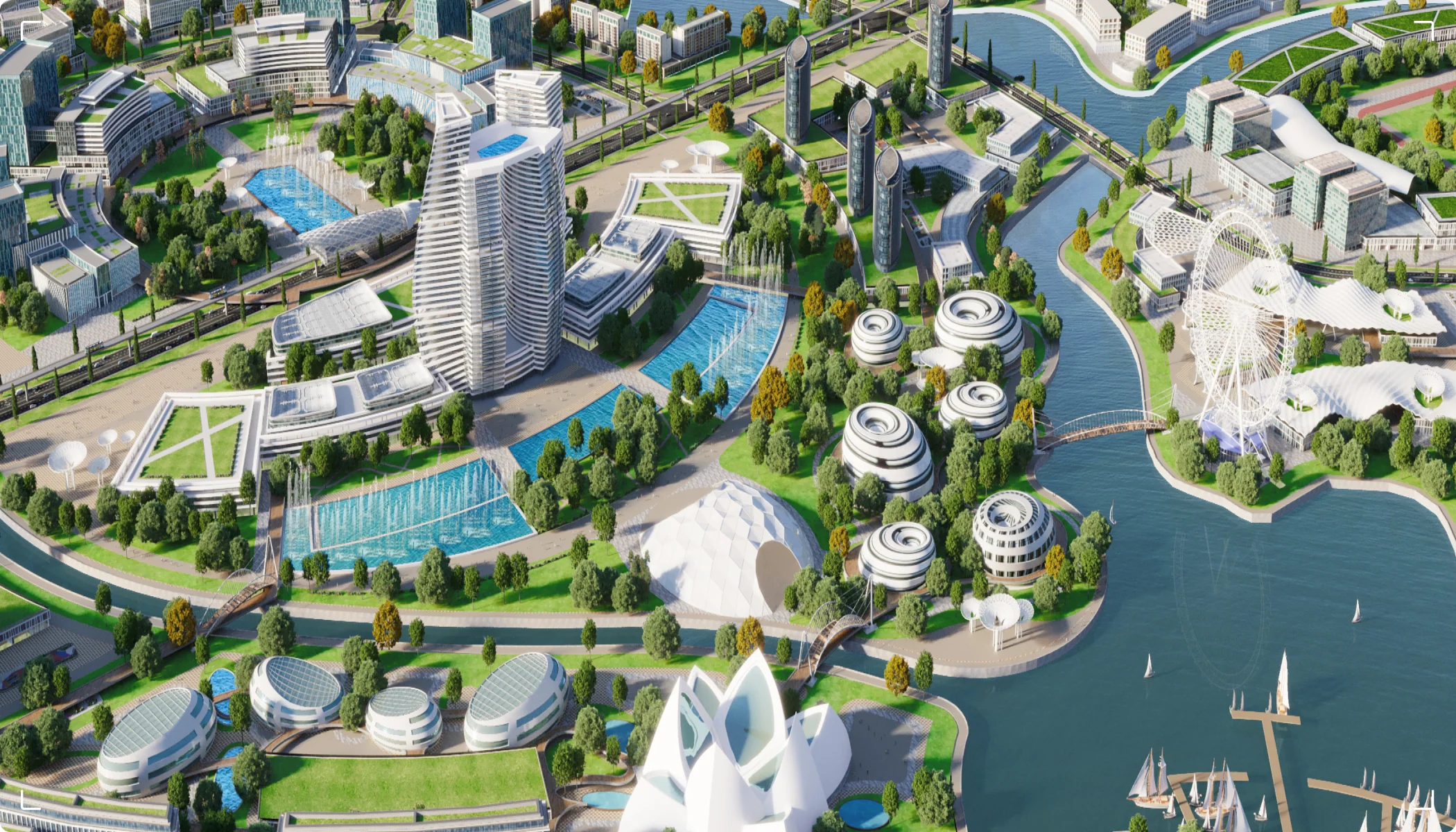
How the City Will Develop
The Development Strategy through to 2050 positions Alatau as a new investment and technology hub in Central Asia. The legal framework for this strategy is established by the Constitutional Law "On the Special Legal Regime of the City of Alatau".
The city is being developed along several areas simultaneously:
- Smart City – digital management of the urban environment and the introduction of artificial intelligence technologies;
- CryptoCity – a regulated environment for digital assets and Web3;
- Urban Air Mobility – an urban air mobility system integrating eVTOL air taxis, unmanned delivery, service drones and digital systems for managing low-altitude airspace.
2024–2026 – Institutional Launch
This period marks the establishment of the city’s legal and governance framework.
In January 2024, the village of Zhetygen was transformed into the city of Alatau. In July 2024, the city's final boundaries were established, covering approximately 88,000 hectares (880 km²). In September 2025, the President of Kazakhstan signed a decree granting Alatau the status of a city of accelerated development. In May 2026, the Constitutional Law "On the Special Legal Regime of the City of Alatau" was signed, with its provisions being introduced in stages from 1 July 2026 to 1 July 2027.
Alongside the establishment of the city’s governance system and legal framework, Alatau City is holding international roadshows to present its investment opportunities. Roadshows in South Korea took place in October 2025 and September 2026. In June 2026, a roadshow was held in China (Shenzhen, Hong Kong and Macao), resulting in the signing of 30 memorandums and agreements with a combined investment potential of more than USD 6 billion in digital infrastructure, artificial intelligence, computing capacity and fintech. Roadshows in Germany and the United Kingdom are scheduled for autumn 2026.
The city’s investment portfolio is expanding. As of the end of 2025, 18 major projects with a total value of approximately KZT 1 trillion were under implementation in Alatau, providing for the creation of more than 21,000 jobs. The investment pipeline comprised 41 projects. By mid-2026, Alatau’s investment portfolio had grown to 67 projects worth more than USD 6.9 billion, with the potential to create over 55,000 jobs.
By 2030 – First Phase of Construction
The first phase focuses on developing basic infrastructure and launching anchor projects in Gateway District and Administrative City Center.
Key Projects and Milestones:
- Construction of the Iconic Complex mixed-use development in Gateway District – two towers, 272 and 78 metres tall, designed by the American architecture firm Skidmore, Owings & Merrill (SOM). Completion is scheduled for 2029.
- Construction of K-PARK in Administrative City Center – a cultural and business centre and a themed park dedicated to Korean culture. Construction began in September 2025. The project is scheduled for completion by 2027, marking the 90th anniversary of the deportation of Koreans to Kazakhstan.
- Launch of commercial eVTOL air taxi services, scheduled for late 2028 – early 2029. The first demonstration flights took place on 19 May 2026.
- Development of the city’s transport network, including integration with the Big Almaty Ring Road (BAKAD) and the development of the street and road network.
By 2050 – Full Implementation
The long-term development horizon envisages the completion of construction across all four districts and the city reaching its target indicators.
| Indicator | Target by 2050 |
|---|---|
| Population | 1.87 million |
| Jobs | Approximately 1 million |
| Tourist arrivals | More than 4 million per year |
| Housing stock | Over 55 million m² |
| Alatau Airport design capacity | Up to 40 million passengers per year |
| Academic town capacity | 40,000 students |
| Healthcare facilities | 102, including 2 multidisciplinary hospitals |
| Schools | 173 |
| Kindergartens | 227 |
By 2050, the combined population of Alatau and Almaty is projected to reach 5 million.
Financing Model
Alatau is being developed primarily through private investment. Public funds are allocated to the construction of basic trunk infrastructure, while commercial, industrial and residential facilities are being built using private capital. In May 2025, the launch of a private investment programme worth approximately USD 1 billion was announced. The programme is aimed at establishing a network of data centres, developing the fintech ecosystem and launching an urban air mobility system.
Alatau in Numbers
City established:
January 2024
Area:
Approximately 88,000 hectares (880 km²)
Population:
54,747 (December 2025)
First phase of construction:
by 2030
Full implementation:
by 2050
Master Plan development:
With the participation of Singapore-based company Surbana Jurong
Legal regime:
Special legal regime, being introduced in stages over a one-year period starting on 1 July 2026