Priority Sectors
Alatau has identified ten priority investment sectors, ranging from real estate and industry to artificial intelligence, Web3, urban air mobility and biotechnology. These priorities reflect the specialisations of the city’s four districts, its strategic transport location and the opportunities provided by the special legal regime to test new technologies and business models. The President of Kazakhstan has identified the IT sector, industry, transport and logistics, tourism, healthcare and education as priority areas.
Why Alatau Is Developing Its Own Sectoral Profile
Alatau’s sectoral development combines two complementary directions.
The first focuses on the development of the city itself and includes real estate, infrastructure, industry, logistics, research and education, healthcare and tourism.
The second brings together emerging technology markets – artificial intelligence, Web3, fintech and urban air mobility – for which Alatau is developing the necessary infrastructure and regulatory environment.
This combination makes it possible to develop the industries required to build and operate a new city while also establishing emerging sectors that may become part of its technological specialisation in the future.
Priority Investment Sectors
01
Real Estate and Infrastructure
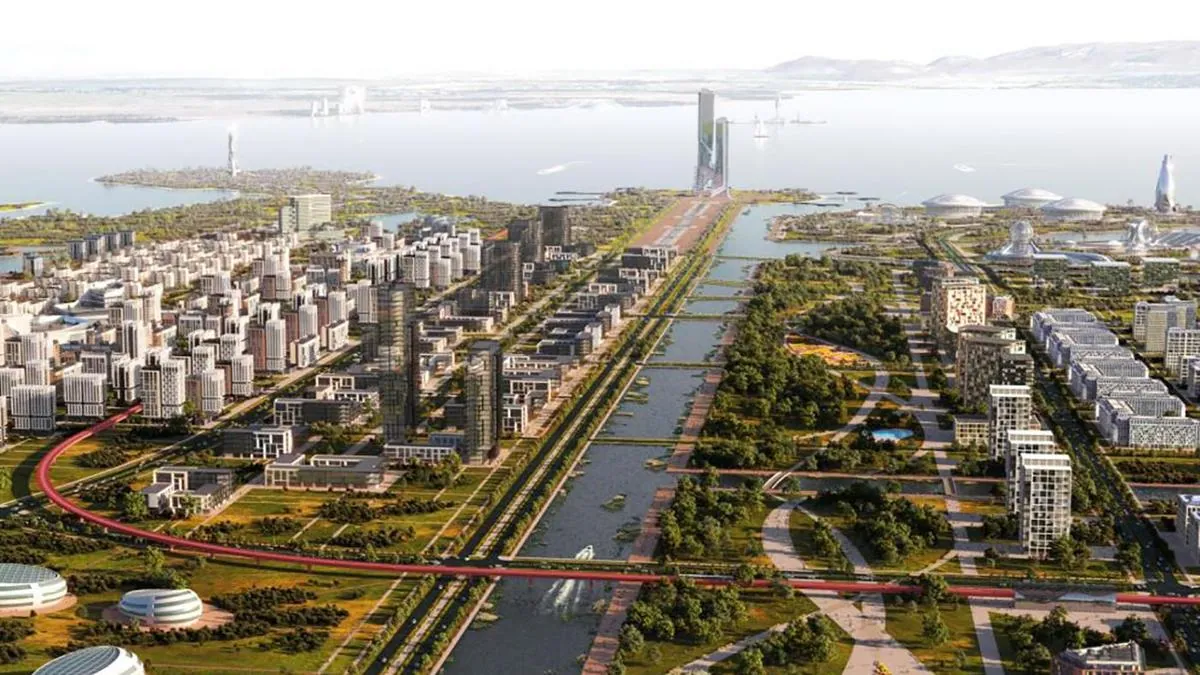
Alatau is being developed from the ground up across an area of approximately 88,000 hectares, making real estate and urban infrastructure fundamental areas for investment. As the city grows, demand will develop for residential, commercial, office and hospitality properties, as well as infrastructure serving new business, industrial and public areas.
Each of the four districts offers distinct development opportunities. Gateway District is focused on business and financial real estate; Administrative City Center on educational and healthcare infrastructure; Growing District on industrial and logistics facilities; and Green District on tourism and recreational infrastructure.
02
Industry
Growing District is being designed as an export-oriented industrial zone with access to transport routes connecting Kazakhstan with markets in Central Asia, China and Europe. Priority is given to environmentally friendly manufacturing facilities that comply with international standards.
Major international manufacturers, including Mars and PepsiCo, are already operating in Alatau. The special legal regime provides industrial projects with tax incentives for up to 30 years.
03
Logistics
Alatau’s location along the Western Europe–Western China International Transport Corridor and approximately 300 km from the Khorgos Gateway creates favourable conditions for logistics and export-oriented projects.
A major logistics hub is planned for Growing District. Alatau’s Master Plan also provides for the construction of Alatau International Airport, with a projected capacity of up to 40 million passengers per year. A 500-hectare logistics zone is planned as part of the airport’s development to support cargo transportation.
04
Financial Technology
Financial technology is among Alatau’s priority development sectors. The city’s special legal regime creates opportunities for fintech companies working with payment services, digital financial instruments and other technological solutions for businesses and the urban economy.
Additional opportunities are associated with the development of CryptoCity and the establishment of a regulatory environment for digital assets and new financial services. Another important factor is Alatau’s proximity to Almaty, Kazakhstan’s largest financial centre, providing access to an established financial sector, investors and skilled professionals.
05
Web3 and Digital Assets
Alatau has been designated as a platform for the development of CryptoCity, where new regulatory models for digital assets and related services are planned to be tested. The Alatau CryptoCity concept envisages the development of a Web3 ecosystem and the launch of asset tokenisation projects. The first tokenisation projects and the attraction of residents are planned by the end of 2026. Specific rules and mechanisms governing CryptoCity’s operations are currently under development.
06
Artificial Intelligence
The Alatau AI-Driven City concept envisages the use of a digital twin of the city, Big Data and artificial intelligence technologies to manage urban infrastructure in real time. As the city develops, this will generate demand for AI solutions in infrastructure management, transport, energy and public safety.
The K-Smart City project envisages the development of a 330-hectare pilot district incorporating smart city technologies and South Korean expertise.
07
Low Altitude Economy (Urban Air Mobility)
Alatau is a pilot zone for the development of urban air mobility, including passenger eVTOL aircraft, unmanned delivery services and digital systems for managing low-altitude airspace. On 19 May 2026, the first demonstration flight of an eVTOL air taxi in Central Asia took place here. Commercial operations are planned for late 2028 to early 2029, with six vertiports planned for the initial phase.
In 2026, Kazakhstan established a legal framework for advanced air mobility for the first time, defining the status of eVTOL aircraft and vertiports, as well as certification requirements for aircraft and unmanned systems.
08
Biotechnology and Healthcare
Administrative City Center is being developed as a medical and research cluster, with a multidisciplinary medical centre designed to meet international standards. This sector focuses on medical technologies, biotechnology research and development, as well as medical tourism.
Proximity to Almaty, with its medical institutions, universities and research facilities, provides access to the specialists and expertise needed to develop projects in healthcare and biotechnology.
09
Education and Research
Administrative City Center is planned to host the International Centre for Education, Healthcare and Sports, including an academic campus for 40,000 students. This sector encompasses university campuses, research centres, educational platforms and facilities for training professionals to meet the needs of the city’s industrial and technology projects.
One of the key projects will be a branch campus of the Korea Advanced Institute of Science and Technology (KAIST). The university will focus on training specialists and advancing research in artificial intelligence, digital technologies and engineering.
10
Tourism and Entertainment
Green District, located on the shore of the Kapshagay Reservoir, is being developed as a year-round tourism and recreation cluster. This sector includes hospitality infrastructure, resorts, amusement parks, sports facilities and event tourism.
The development of Green District will be one of the key components of Alatau’s tourism infrastructure. By 2050, the city’s total annual tourist flow is expected to exceed four million visitors.