
How Alatau Differs from Other Cities in Kazakhstan
Alatau operates under a special legal regime that establishes specific rules for governance and business operations. These include business licensing, tax incentives and investor guarantees. Experimental regulatory regimes may also be introduced to test new technologies.
The provisions of the special regime take precedence over other laws of Kazakhstan, except for the Constitution and ratified international treaties. Alatau’s status as a city of accelerated development remains in effect until 2050. During this period, transfers from Alatau’s budget to the national budget are prohibited.
Alatau’s development is overseen by the Alatau City Authority and the City Council. The Akimat performs the functions of the local executive body, while the Maslikhat serves as the local representative body.
Alatau City and the Alatau Special Economic Zone: Key Differences
The Alatau Special Economic Zone (SEZ) is a designated territory where participants are eligible for tax and customs incentives, subject to established requirements. The SEZ framework is linked to the development of Alatau as a hub for investment, technology and entrepreneurship. The zone was established by a Government resolution on 15 March 2023 under the name “G4 City”. Later that year, the concept was revised: instead of four satellite cities, a single city with four districts was planned. On 26 December 2023, the zone was renamed the Alatau SEZ.
The boundaries of the city and the SEZ do not coincide. Alatau City covers approximately 88,000 hectares. Following its renaming and expansion in 2023, the SEZ covered 96,500 hectares. Under Government Resolution No. 990 of 20 November 2025, its area was increased to 98,982.98 hectares (approximately 99,000 hectares).
In 2026, the Constitutional Law "On the Special Legal Regime of the City of Alatau" was adopted, with its provisions being introduced in stages starting from 1 July 2026. The Law established a broader legal framework: alongside provisions for investment projects, the special regime covers city governance, budgetary relations, infrastructure, digitalisation and the protection of business rights. During the transition period, the SEZ mechanisms continue to apply within the scope defined by the transitional provisions of the legislation.
The Digital by Default Principle
Digital by Default is a principle under which city services and governance processes are designed from the outset to operate in a digital environment. It is enshrined in the Constitutional Law and forms the basis of Alatau’s technology model.
This principle underpins the Smart City concept, which includes digital urban services and a digital twin. Another area of development is CryptoCity, which focuses on the regulated use of digital assets. The operational rules for CryptoCity have not yet been approved.
Alatau’s digital model is designed to cover both existing microdistricts and businesses and the city’s new districts.
The Link Between the City’s Districts and Its Economy
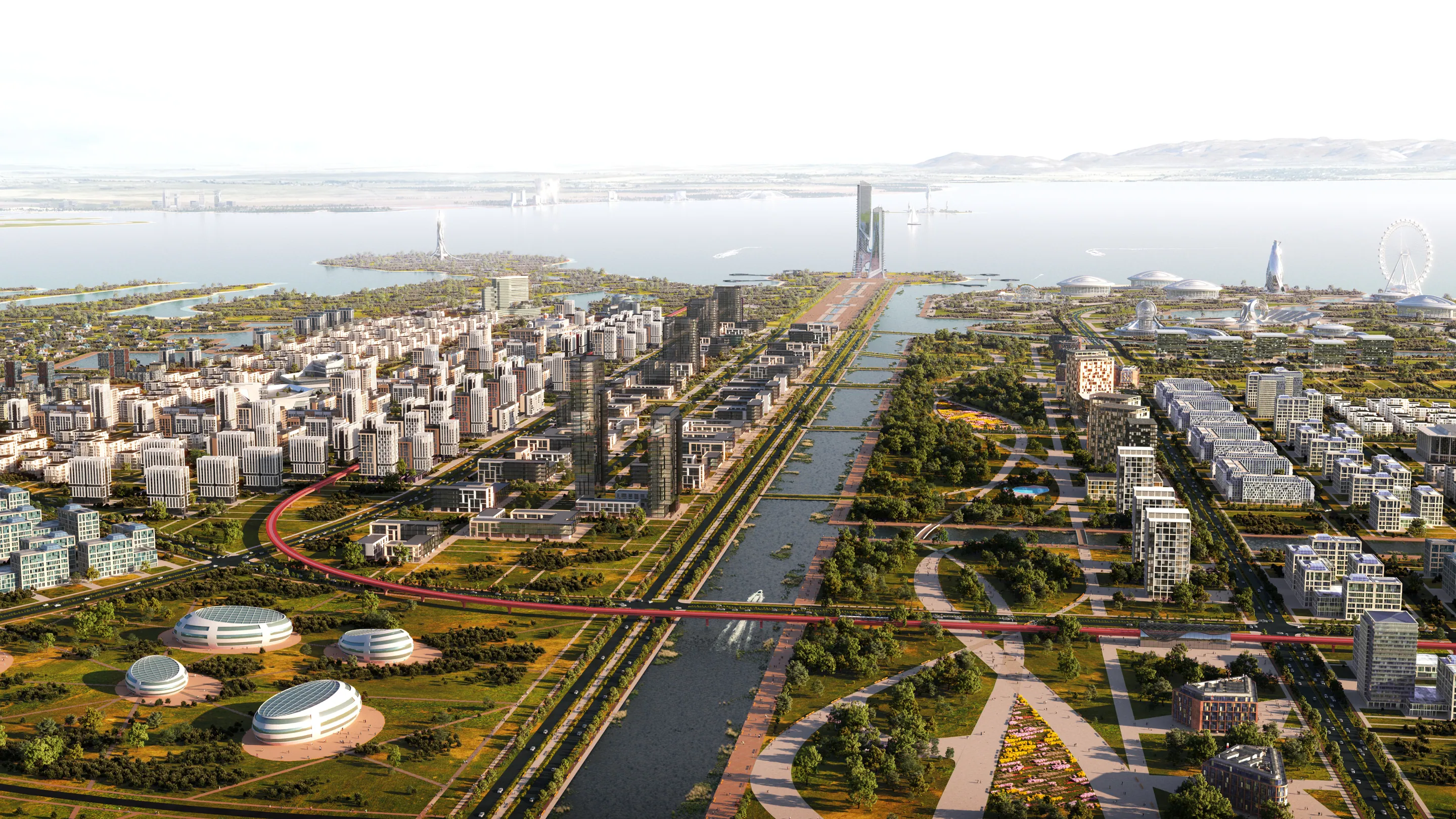
Alatau’s Master Plan, developed with the participation of Singapore-based Surbana Jurong, provides for four districts: Gateway – business and finance; Administrative City Center – science, education and healthcare; Growing – industry and logistics; and Green – tourism and recreation.
Each district will also include residential areas and social infrastructure alongside facilities related to its specific specialisation.
Financing the Development of Alatau City
The Constitutional Law establishes the priority of private investment. Kazakhstani and foreign investors finance commercial, residential, industrial and technology facilities. Public funds are allocated to transport, utility, energy and social infrastructure.